
Metric vs imperial bolts: the lookalikes that bite
Metric vs imperial bolts: how the world ended up with two thread systems, the near-identical pairs that cross-thread, and how to ID a mystery bolt fast.
June 1990. A British Airways jet is climbing out of Birmingham, and at about 17,300 feet the captain's windscreen blows out. He gets sucked halfway out of the plane.
He survived. The crew held onto his legs.
The cause, per the official accident report: 84 of the 90 windscreen bolts were 8-32s instead of 10-32s. Same pitch, about 0.66 mm skinnier, matched by eyeballing them side by side.
Two imperial sizes. Same system. Almost the same bolt.
Now imagine metric vs imperial bolts — two entire systems full of almost-the-same. That's why your hardware bin needs a divider down the middle. Here's how we ended up with two, the specific pairs that'll get you, and how to tell a mystery bolt apart in about thirty seconds.
How the world ended up with two
Back in the early history of nuts and bolts, every shop cut threads its own way. In 1841, Joseph Whitworth stood up at the Institution of Civil Engineers in London and opened his paper with:
"Great inconvenience is found to arise from the variety of threads adopted by different manufacturers."
So he collected bolts from workshops all over England, averaged them, and proposed one standard: a 55° thread with rounded tops and bottoms. The British railways adopted it, and it took over.
In April 1864, William Sellers proposed something different to the Franklin Institute in Philadelphia: a 60° thread with flat tops. According to the ASME's history, the big selling point was that it was easier for ordinary machinists to cut. The US Navy adopted it in 1868, and by the 1880s it had won America.
Meanwhile, continental Europe went metric. A congress in Zurich in 1898 adopted a 60° metric thread that eventually became the ISO metric thread most of the world uses today.
So now there's three.
Then two world wars happened
Turns out "the Americans and the British can't share spare parts" is a real problem when you're on the same side of a war.
The US Congress set up a National Screw Thread Commission in 1918 because the mess was causing problems buying munitions in World War I. In World War II, Packard built Rolls-Royce Merlin aircraft engines in the US — and since no American toolmaker made Whitworth taps and dies, Packard had to make their own. Canada had it worst. As one Canadian standards official put it at the signing ceremony:
"Through two world wars Canada worked with two thread standards and two gage systems."
Finally, on November 18, 1948, the US, the UK and Canada signed an accord in Washington creating the Unified inch thread. 60°, like Sellers'. The British side admitted that Britain was "in fact making the major departure from previous practice."
The record of that signing is a great read, by the way. Very polite people being very relieved.
ISO was founded in 1947 and metric threads became one of its first big standards. And here's my favorite bit of trivia: since 1959, an inch has been officially defined as exactly 25.4 millimetres. The inch literally is a metric unit now. (Yes, I'm going to keep measuring in millimetres.)
The lookalikes that'll get you
Here's what nobody's chart shows you: the pairs that are close enough to start threading.
| Pair | Diameter | Pitch | How bad | |---|---|---|---| | M3 vs #4-40 | 3.00 vs 2.84 mm | 0.50 vs 0.64 mm | Binds fast | | M4 vs #8-32 | 4.00 vs 4.17 mm | 0.70 vs 0.79 mm | Binds fast | | M5 vs #10-32 | 5.00 vs 4.83 mm | 0.80 vs 0.79 mm | Dangerous | | M6 vs 1/4"-20 | 6.00 vs 6.35 mm | 1.00 vs 1.27 mm | Obvious-ish | | M8 vs 5/16"-18 | 8.00 vs 7.94 mm | 1.25 vs 1.41 mm | Starts, then binds | | M10 vs 3/8"-16 | 10.00 vs 9.53 mm | 1.50 vs 1.59 mm | Binds |
Look at M5 and 10-32. The pitches are 0.800 and 0.794 mm. That's a difference of six thousandths of a millimetre per thread. A 10-32 screw will spin right into an M5 nut, feel a little loose, and hold — until it doesn't.
M8 vs 5/16" is the opposite trap: the diameters are basically identical (0.06 mm apart), so it slips right in. Then the pitch catches up a couple turns later and it binds. If you crank it from there, you've just screwed up both. (Pun fully intended.)
If it starts easy and gets tight after two turns, stop. It's the wrong thread.
Tools that almost fit
Same deal with your wrenches and hex keys:
- 4 mm vs 5/32" hex key (M5 vs #10 socket heads): 0.03 mm apart. Honestly interchangeable.
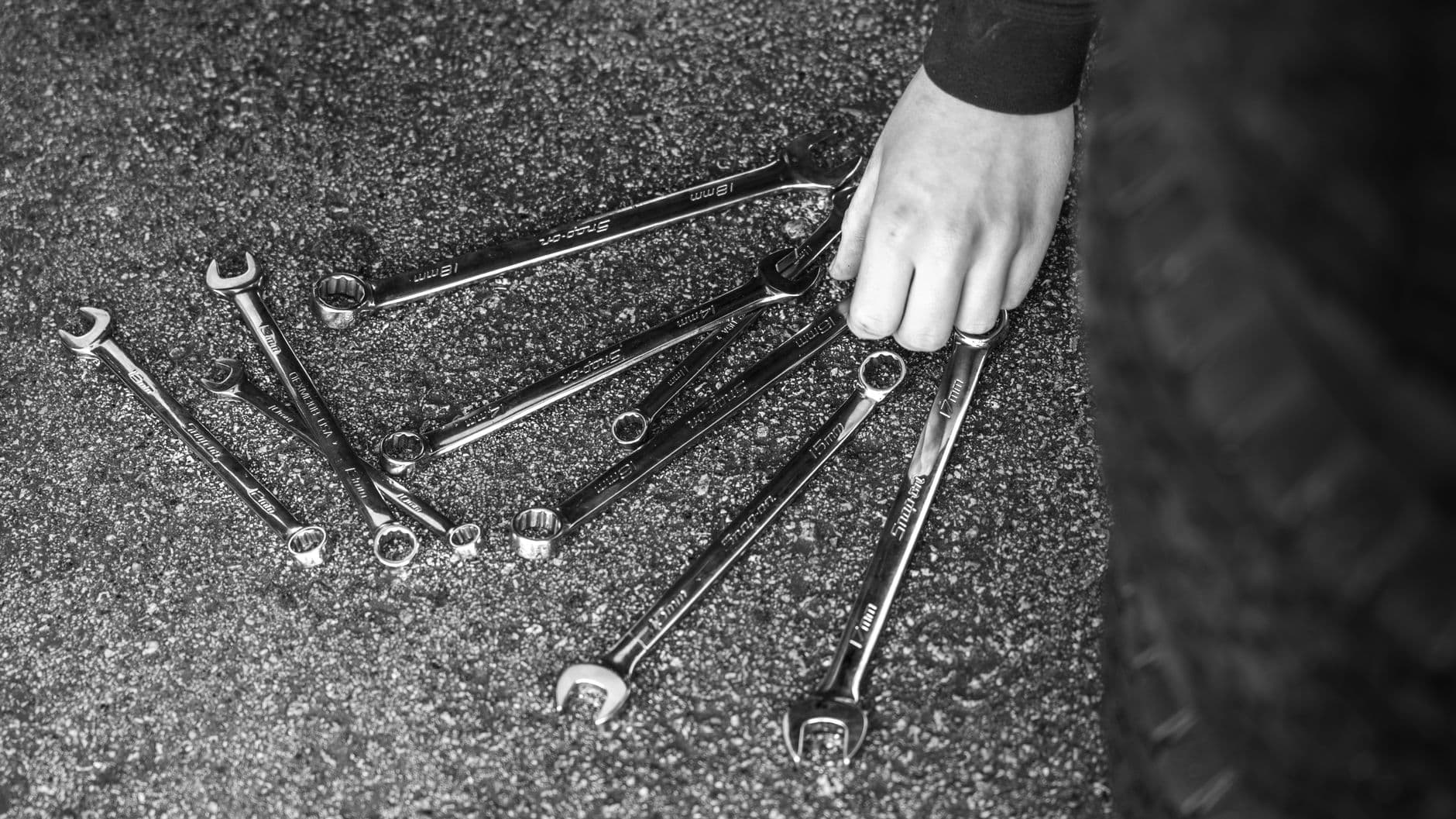
- 13 mm wrench on a 1/2" nut (M8 vs 5/16"): 0.3 mm loose. That's enough to round the nut off.
- 10 mm vs 7/16" (M6 vs 1/4" nuts): over a millimetre apart. Not even close, but it'll look close in a dark corner.
And flat head screws: metric heads are 90°, imperial are 82°. Put one in the other's countersink and it either sits proud or only clamps on its rim. (Full countersink breakdown here.)
The survivors hiding in your stuff
Even in a metric world, a few imperial and Whitworth threads refuse to die:
- Your camera tripod. Nearly every camera uses a 1/4"-20 mount (and big tripods use 3/8"-16). It's in the ISO standard. An imperial thread in the most metric product imaginable.
- Your plumbing. British pipe threads (BSP) still use Whitworth's 55° angle, and American pipe threads (NPT) are 60°. Swagelok's identification guide says 1/2" and 3/4" BSPT and NPT can be so close that you might not be able to tell them apart without an optical comparator. That's not a typo.
- Your bike pedals. Most are 9/16" × 20 TPI. Old French bikes used 14 × 1.25 mm. Sheldon Brown's warning about mixing them: it "will start to thread… but will soon bind. Do not force it, or it will damage the crank."
- Old British cars and motorcycles. Whitworth wrenches are stamped by the bolt size, not the jaw size — a "1/4W" wrench fits a 1/4" Whitworth bolt. Which confuses the hell out of literally everyone.
How to ID a mystery bolt
Found a loose bolt on the floor. Is it metric?
- Calipers on the threads (outside diameter). Close to a whole millimetre? Probably metric. Close to a fraction of an inch or a numbered size? Probably imperial.
- Thread pitch gauge. Try leaves until one sits with no light showing. No gauge? Measure across 10 threads in mm and divide by 10.
- Check the head. A number like 8.8 or 10.9 means metric. Radial lines (3 or 6) mean an inch-grade bolt.
- Check the table above. If you land on M5/10-32 or M8/5/16, try it in a known nut before you trust it.
Swagelok's guide says it best: "Even experienced workers sometimes have difficulty identifying threads." So don't feel bad. Just keep two bins. Label them like you mean it.
Matching the oddballs
When you need a thread you can't buy locally — an old Whitworth knob, a weird imperial tripod adapter, an M5 that has to match a 10-32 you're stuck with — that's where printing your own comes in.
The Nasty Bastard bolt generator has metric coarse and fine plus UNC/UNF presets, and a custom mode: measure the diameter and pitch of the bolt you're matching, punch them in, and it'll build the mating nut. And when you finally figure out what that mystery bolt is, save the numbers in the Slutty Measurement Vault so you never have to measure it again.
So — which bin does that bolt on your floor go in?
Frequently asked questions
- Can you use a metric nut on an imperial bolt?
- Generally no. Most pairs have different pitches, so they bind after a turn or two and damage the threads. The dangerous exception is M5 and #10-32: their pitches are 0.800 and 0.794 mm, so a 10-32 screw can thread into an M5 nut and feel fine while holding poorly. Never force a thread that starts easy and then gets tight.
- How can I tell if a bolt is metric or imperial?
- Measure the outside diameter with calipers, check the pitch with a thread gauge (or measure across 10 threads and divide by 10), and look at the head: property class numbers like 8.8 or 10.9 mean metric, while radial lines mean an inch-grade bolt.
- Is M8 the same as 5/16 inch?
- No. The diameters are nearly identical (8.00 mm vs 7.94 mm), but the pitch is different — 1.25 mm for M8 coarse vs about 1.41 mm for 5/16-18. They'll start to thread and then bind.
- Why are there metric and imperial threads?
- Britain standardized on Whitworth's 55-degree thread in 1841, the US on Sellers' 60-degree thread in 1864, and continental Europe went metric. After two world wars of incompatible parts, the US, UK and Canada agreed on the Unified inch thread in 1948, while ISO metric threads became the standard in most of the world.