
The history of nuts and bolts (it's weirder than you think)
Nuts and bolts used to come in matched pairs — literally marked as belonging to each other. Here's how we got from hand-filed threads to the M3 in your bin.
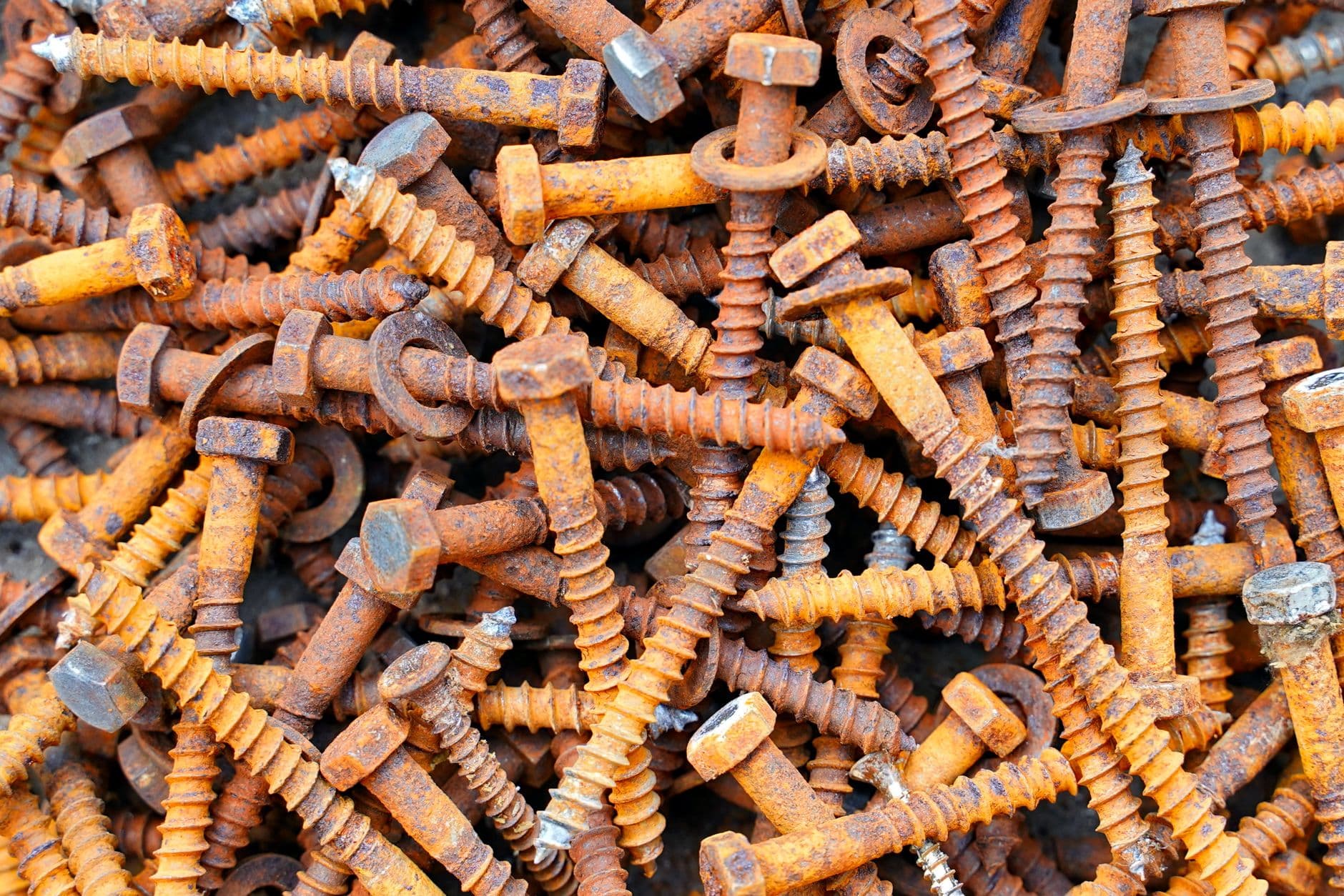
Dump a bag of M3 bolts on your bench. Now go grab an M3 nut from a different bag. Different brand, different country, bought three years apart.
It threads right on.
That's kind of insane, and the history of nuts and bolts is mostly the story of how long it took to get there. For about two thousand years, a nut fit one bolt. Its bolt. The one it was made with. Any other bolt in the building was a stranger.
Here's how we got from that to a bin of interchangeable hardware you don't even think about.
The screw came first. Way first.
Before there were nuts, there were screws — and nobody's totally sure who gets the credit.
Archytas of Tarentum is traditionally credited with the screw around 400 BC. Archimedes gets the water screw, the big helix in a tube that lifts water uphill. Except the surviving physical evidence for those only goes back to the 1st century AD, and at least one historian has argued the Assyrians were running bronze water screws centuries before Archimedes was born. So: "traditionally credited." Historians are still fighting about it, and I'm not getting in the middle of that.
What we do know is the Romans loved a screw press. By the 1st century BC, big wooden screws were squeezing olives and grapes all over the Mediterranean.
And then somebody needed a female thread.
A screw press works way better if the screw turns inside a threaded beam instead of against a lever. The Greek engineer Hero of Alexandria wrote up a tool for exactly that in the 1st century AD — a cutter for carving an internal thread into a wooden plank, described in his book Mechanica. A wooden nut, basically. Possibly the first documented nut-maker in history, and it was for making wine.
Honestly? Respect.
Metal nuts show up (and they're all custom)
Fast forward a long way. Metal screws and nuts start appearing in Europe in the 1400s. Gutenberg's printing press, around 1440, was a converted screw press. Same machine that squeezed the grapes, now squeezing ink onto paper.
The tools to make threads were getting smarter too. Leonardo da Vinci sketched screw-cutting machines with swappable gears for different pitches around 1500. Jacques Besson published a screw-cutting lathe in 1569 that guided the cutter off a master screw.
But here's the catch nobody mentions.
Every thread was still basically handmade. Samuel Smiles, writing in 1863 about how things worked before the machine age, put it perfectly:
"Every bolt and nut was sort of specialty in itself… all bolts and their corresponding nuts had to be marked as belonging to each other; and any mixing of them together led to endless trouble, hopeless confusion, and enormous expense."
That's from his Industrial Biography. Read it again. Marked as belonging to each other.
Imagine if every M3 in your printer only fit its own nut. You strip one, you don't grab another — you make a new pair, by hand, with a file. Every shop cut threads its own way. A bolt from one workshop was useless in the next town over.
That's what "custom hardware" meant for most of human history, and it sucked.
The lathe that copied itself
The fix was a machine that made the same thread every time.
Jesse Ramsden built special screw-cutting lathes in the 1770s to make ultra-precise screws for his scientific instruments. But the guy who turned it into a workshop tool was Henry Maudslay, around 1797–1800.
His trick was a leadscrew. A long, accurate master screw runs alongside the work, geared to the spindle with change wheels. Every turn of the part moves the cutting tool a precise distance. Swap the gears, change the pitch. The Science Museum still has his original lathe, and the museum's own description is blunt: before it, "screw threads were crudely manufactured by hand."
Then he got a little carried away.
Smiles describes Maudslay cutting a screw 5 feet long and 2 inches across, at 50 threads per inch, with a nut 12 inches long holding 600 threads. It was for dividing the scales on astronomical instruments, so there was a reason.
Still. Six hundred threads in one nut. That's a hell of a flex.
He also built a bench micrometer his shop nicknamed the "Lord Chancellor," because it was the final court of appeal for any measurement argument. I love that so much. Every shop needs a Lord Chancellor. (Mine's a pair of digital calipers and a sticky note that says measure twice.)
His apprentice, James Nasmyth, later got stuck making around 300 tiny steel nuts and bolts for an engine model, all needing perfect hex flats. Filing them by hand was "practically impossible," so he built a little machine with a rotating cutter and an indexing plate to do it instead. That's the maker instinct right there. The job's too tedious, so you build a tool for the job.
Then everybody had to agree
A lathe that repeats a thread solves your shop. It doesn't solve the shop across town using a different thread.
So in 1841, Joseph Whitworth proposed one standard thread for Britain — a 55° thread angle with rounded tops. In 1864, William Sellers proposed a 60° thread with flat tops for the US, mostly because it was easier to make. Two standards. Two countries. Two wars' worth of mismatched spare parts later, the US, UK and Canada finally agreed on a shared "Unified" inch thread in 1948, and metric ISO threads took over most of the rest of the world.
(That fight deserves its own post, and it's getting one.)
Fun footnote: the Crystal Palace, built for the 1851 Great Exhibition, went up with tens of thousands of bolts. A 2024 study of a couple of surviving ones found they matched Whitworth's thread — decades before Britain made it the official standard. It's only two bolts, so don't go betting on it. But it's a fun theory.
The nut that refused to back off
Fast forward again. Vibration loosens nuts. Ask anybody with a printer that shakes itself apart.
In 1927, Carl Swanstrom came over from Sweden with a license for a self-locking nut, and the Elastic Stop Nut Corporation of America grew out of it. The original locking insert wasn't nylon though — it was vulcanized fiber. Nylon didn't replace it until a patent filed in 1944 and granted in 1948, because fiber soaked up water and didn't survive being reused.
That's the nyloc in your hardware bin. The one with the colored ring.
Here's the maker tip hiding in that history: the FAA's own maintenance guide says fiber and nylon lock nuts don't go anywhere above 250°F (121°C). Your hotend runs 200°C+. Don't put a nyloc anywhere near the heater block. Use a regular nut and a bit of thread locker, or an all-metal lock nut.
Reading the bolt in your hand
The other big upgrade was knowing what you're holding.
- Inch bolts (SAE J429): no marks on the head is Grade 2 (soft), three radial lines is Grade 5, six lines is Grade 8.
- Metric bolts (ISO 898-1): the number on the head is the property class. 8.8 means 800 MPa tensile strength, and the yield point is 80% of that — 640 MPa. A 10.9 is stronger still.
So that's what those little numbers on your socket head caps mean. You're welcome. 😅
When one nut carried too much
One more, and it's a serious one.
In 1981, two walkways collapsed at the Hyatt Regency in Kansas City, and over a hundred people were killed. The original design hung both walkways from long continuous rods. During construction, that got changed to two offset sets of rods — which meant the connection at the upper walkway was now carrying both walkways. The investigation by the National Bureau of Standards (now NIST) pinned it on that box beam–hanger rod connection. The beam split along its weld, and the nut holding it pulled right through.
It looked like a small detailing change.
It wasn't.
I'm not putting that here for drama. I'm putting it here because it's the most important lesson in the whole history of fasteners: when you change how a part is joined, re-check what every nut is actually holding.
So why does this matter at your bench?
Every time a store-bought M3 nut threads onto your printed part, you're cashing in on a couple hundred years of people agreeing on a diameter, a pitch, and an angle.
That's the whole reason our bolt generator, the Nasty Bastard, works off standard sizes. Pick M3 through M20 or UNC/UNF, and the thread it builds matches the real hardware — tap drill and clearance hole included. Go custom if you want to be Maudslay about it. And if you want the printing side, here's how to print nuts and bolts that actually thread.
Oh, and the phrase "nuts and bolts," meaning the basic practical details? It only shows up around 1952. The hardware is ancient. The cliché's younger than your grandpa.
So what's in your bin that you've never once thought about?
Frequently asked questions
- Who invented nuts and bolts?
- Nobody, in one go. The screw is traditionally credited to Archytas of Tarentum around 400 BC, Hero of Alexandria described a cutter for internal (nut) threads in the 1st century AD, metal screws and nuts appear in the 1400s, and Henry Maudslay's screw-cutting lathe around 1800 is what made matching, repeatable threads practical.
- When were nuts and bolts first standardized?
- Joseph Whitworth proposed the first national thread standard in Britain in 1841. William Sellers proposed the US standard in 1864. The US, UK and Canada agreed on the Unified inch thread in 1948, and ISO metric threads became the standard in most of the world after that.
- Why were old nuts and bolts marked as pairs?
- Before screw-cutting lathes, threads were filed and chipped by hand and every shop cut them its own way. A nut only fit the bolt it was made with, so the two were marked as belonging to each other.
- When were nylon lock nuts invented?
- The Elastic Stop Nut company started in the US in the late 1920s and 1930s using a vulcanized fiber insert. Nylon replaced the fiber with a patent filed in 1944 and granted in 1948. Nylon-insert nuts shouldn't be used above 250°F (121°C).